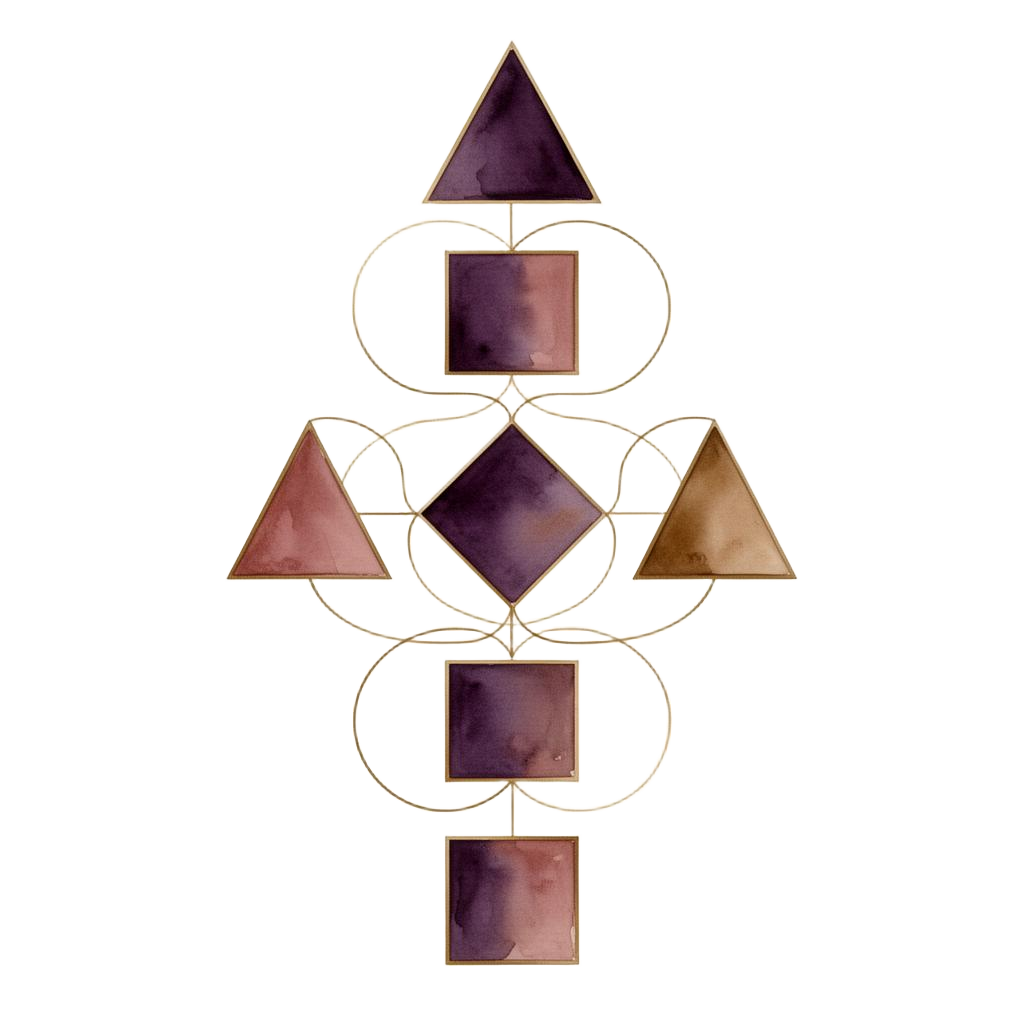
The nine Centres in Human Design are the geometric shapes you see across the bodygraph: the Head, the Ajna, the Throat, the G Centre, the Heart, the Solar Plexus, the Sacral, the Spleen, and the Root. Each Centre governs a specific function, and each one is either defined (coloured in) or undefined (white) on your chart. A defined Centre carries a fixed energy that you reliably broadcast. An undefined Centre is open, taking in and amplifying what is around it.
This single distinction explains an enormous amount about why people are different. Your defined Centres are the parts of you that are consistent regardless of the company you keep. Your undefined Centres are the parts that change shape depending on who you are with, where you are, and what is in the field. Both are correct. Both are necessary. Knowing which is which is what makes the chart practical, and it is one of the first lenses we work with inside She Who Returns when women begin reading their own design.
Defined Centres: what you reliably bring
A defined Centre carries energy you can count on. It is your contribution to every room you enter. If your Throat is defined, you have consistent voice. If your Heart is defined, you have consistent willpower available. If your Sacral is defined, you have consistent life-force. The energy is yours; it does not depend on anyone else.
The trap with defined Centres is assuming everyone else has access to the same consistency you do. They do not. The energy you take for granted is, for someone with the same Centre undefined, an experience that comes and goes depending on whose company they are in.
Undefined Centres: where you are open and conditioned
An undefined Centre is the place you take in and amplify the energy of the people around you. This is the source of much of what we call conditioning: the patterns we pick up because we kept being around the same kinds of people in the same kinds of rooms. The undefined Centres are also where wisdom accumulates over time, because being open to a particular energy lets you eventually become a deep observer of it.
The not-self in Human Design lives mostly in the undefined Centres. Each Centre has a characteristic question that the not-self mind asks, and the question marks the place you are likely to make decisions for the wrong reasons. Knowing the questions is the beginning of stopping the override.
Open Centres are not a problem
It is a common misreading to treat undefined Centres as deficits, as parts of you that are missing or broken. The opposite is closer to the truth. Open Centres are designed to be taken in, sampled, sometimes amplified to extreme intensity, and ultimately understood deeply. The wisdom of the system, especially later in life, often lives in the openness.
A practical reading of your chart starts with noticing where you are defined and where you are open, and then watching, for a few weeks, how each plays out in your daily life. The reality of the design is far more useful than any theoretical interpretation of it.